
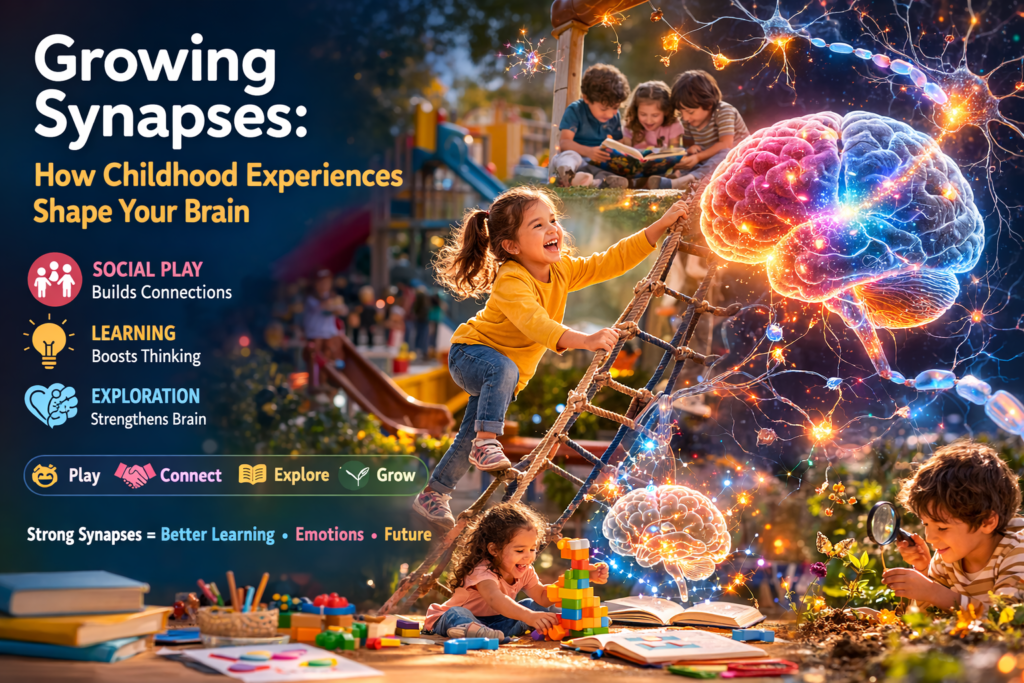
Play is the work of the brain. Neuroscientists remind us that childhood experiences are far more than just fun they are actively building the wiring of our minds. Every laugh, every game, and every conversation a child has is shaping their brain in ways that last a lifetime.
Imagine a child in a playground. She climbs, runs, laughs with friends, and maybe even scrapes her knee along the way. To an outside observer, it’s ordinary play. But inside her brain, something extraordinary is happening. Tiny connections between neurons, called synapses, are forming, breaking, and reforming with every new experience. Think of these synapses as the roads of the brain the more experiences a child has; the stronger and more organized these roads become.
Recent research sheds fascinating light on just how crucial these experiences are. Scientists conducted a study with young rats, dividing them into two groups. One group was allowed to play and interact socially, while the other was kept isolated with minimal social contact. The findings were striking: rats that enjoyed social play developed stronger synaptic connections and exhibited healthier behaviors as they grew. Meanwhile, isolated rats had weaker connections and showed behavioral impairments
This research highlights a simple but powerful truth: social interaction doesn’t just shape personality it physically shapes the brain. Every laugh, every playful moment, every shared experience strengthens the connections that allow the brain to learn, adapt, and thrive.
The human brain continues developing until around 25 years of age, making childhood and adolescence critical periods for building strong, healthy synapses. Experiences especially social ones literally sculpt the brain’s architecture, influencing thinking, learning, and emotional regulation for years to come.
So, what does this mean for children in real life? Encourage play and social interaction; provide diverse experiences like reading and exploring, and avoid-restriction. Embrace challenges and learning, because mistakes help mistakes help synapses grow stronger.
Childhood experiences are more than memories they are the architects of the brain. Social interactions and rich environments strengthen synapses, shaping behavior, learning, and emotional health for life. The playful moments of today are building the brilliant minds of tomorrow.